528 Transport Errors
Fluxzy returns the HTTP 528 status code whenever it cannot start or complete a
request against the upstream server. A transport error covers anything that
prevents Fluxzy from producing a real upstream response, including:
- DNS resolution failures
- TCP connection refusals, resets, or timeouts
- TLS handshake or certificate errors
- Protocol violations from the remote
- Read timeouts or premature connection closes
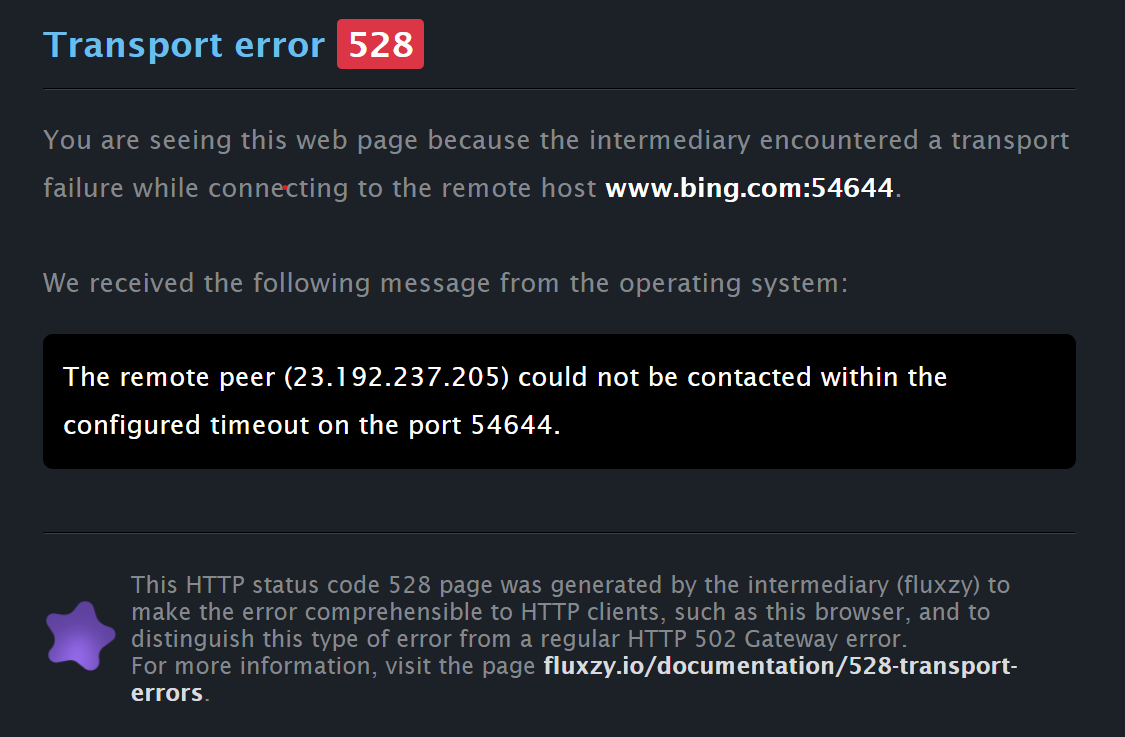
Instead of dropping the connection to the client, Fluxzy synthesizes a 528
response with a human-readable body that summarizes the diagnosis:
Machine-readable diagnosis: x-fluxzy-network-error (Fluxzy.Core v1.36+)
Starting with Fluxzy.Core v1.36, every synthesized 528 response also
carries a short, stable token in the x-fluxzy-network-error header. This lets
tools, test runners, and CI pipelines branch on the exact failure category
without parsing the HTML body.
HTTP/1.1 528 Fluxzy error
x-fluxzy: Fluxzy error
x-fluxzy-network-error: tls_cert_expired
Content-Type: text/html; charset=utf-8
Connection: close

<html>...</html>
The same token is persisted on ClientError.NetworkErrorCode in .fxzy and
HAR archives, so post-mortem readers can recover it.
The token strings are a public contract: they are exposed as
public const stringonFluxzy.Core.NetworkErrorCodesand will not change outside of a major version bump.
Token reference
Connection layer
| Token | Meaning |
|---|---|
connection_refused |
The remote actively refused the TCP connection (RST on SYN). |
connection_reset |
The remote reset an established connection. |
connection_aborted |
The connection was aborted, often a half-close without a clean FIN. |
connection_timeout |
The remote could not be contacted within the configured TCP connect timeout. |
host_unreachable |
The OS reports no route to the remote host (ICMP host-unreachable). |
network_unreachable |
The OS reports no route to the remote network. |
connection_closed |
The remote closed the TCP connection while Fluxzy was reading the response header. |
DNS layer
| Token | Meaning |
|---|---|
dns_notfound |
DNS returned NXDOMAIN: the host does not exist. |
dns_no_data |
The name resolved but no usable A/AAAA record was returned. |
dns_try_again |
Transient DNS failure (SERVFAIL or equivalent); a retry might succeed. |
dns_failure |
Generic DNS failure: malformed response, unreachable resolver, DoH endpoint returning non-2xx. |
TLS layer
| Token | Meaning |
|---|---|
tls_cert_expired |
The server certificate is past (or not yet within) its validity period. |
tls_cert_hostname_mismatch |
The certificate is valid but does not cover the requested hostname (Subject / SAN). |
tls_cert_untrusted |
The certificate chain does not chain to a trusted root. |
tls_cert_invalid |
Other certificate-policy failure: revoked, malformed, or required but missing. |
tls_handshake_failure |
TLS handshake failed for a non-certificate reason (alert, version, cipher, ...). |
Other
| Token | Meaning |
|---|---|
protocol_error |
An HTTP/2 stream protocol error happened before the response header was received. |
rule_failure |
A user-supplied Fluxzy rule (filter or action) threw during exchange processing. |
unknown |
Fallback when none of the categories above match: a wrapped exception with no further detail. |
Reading the token
From an HTTP client (C#)
using var response = await httpClient.GetAsync(url);

if ((int)response.StatusCode == 528 &&
    response.Headers.TryGetValues("x-fluxzy-network-error", out var values))
{
    var token = values.Single();
    // Compare against Fluxzy.Core.NetworkErrorCodes.* constants
}
From a Fluxzy archive
foreach (var clientError in exchange.ClientErrors)
{
    var token = clientError.NetworkErrorCode; // null on success
}
Common error messages (response body)
The synthesized body still describes each failure in plain English. The most common cases:
The connection was reset by remote peer `
x-fluxzy-network-error: connection_reset. The remote requested an immediate
TCP termination, either during the handshake or amid an active connection.
This usually means there is no path-level network issue; the remote chose to
hang up.
The remote peer could not be contacted within the configured timeout
x-fluxzy-network-error: connection_timeout. The TCP connect did not complete
in time. Common causes:
- The remote is not reachable (no route to host).
- The remote is reachable but silently drops the SYN (firewall, closed port).
- The response is lost on the way back (routing issue).
- The path is too slow to complete the handshake within the timeout.
Failed to solve DNS for hostname
x-fluxzy-network-error: dns_notfound, dns_no_data, dns_try_again, or
dns_failure. DNS resolution did not yield a usable IP. Causes:
- The hostname does not exist (
NXDOMAIN). - The resolver is unreachable or did not respond in time.
- The resolver returned an error (
SERVFAIL) or noA/AAAArecord. - The response was malformed.
Use 502 instead of 528
Strictly speaking, an intermediary should return 502 Bad Gateway for an
upstream failure. Fluxzy uses 528 by default so that a debugging response is
easy to tell apart from a genuine reverse-proxy failure. To switch back to
502:
- Fluxzy CLI: pass
--use-502to thestartcommand. - Fluxzy Desktop: Settings → Proxy settings.
- Fluxzy Core: set
FluxzySharedSetting.Use528 = false.
The x-fluxzy-network-error header is emitted in both modes.
More diagnosis
For deeper diagnosis, set the environment variable
EnableDumpStackTraceOn502=TRUE to include the underlying stack trace in the
synthesized body.
See also
Fluxzy.Core.NetworkErrorCodes: canonical list of token constants.ClientError.NetworkErrorCode: token persisted on archived exchanges.NetworkErrorFilter: selects exchanges whose status code is528in rules.